What design actually decides
Four decisions before a single pixel.
Information architecture
Which pages exist and why. Most business sites have too many pages saying too little — we map what buyers actually need to know and give each need one strong page, so nothing competes with itself.
The buyer journey
Where each kind of visitor lands, what convinces them, and the single next action every page drives toward. A page without a decided action is decoration.
Content hierarchy
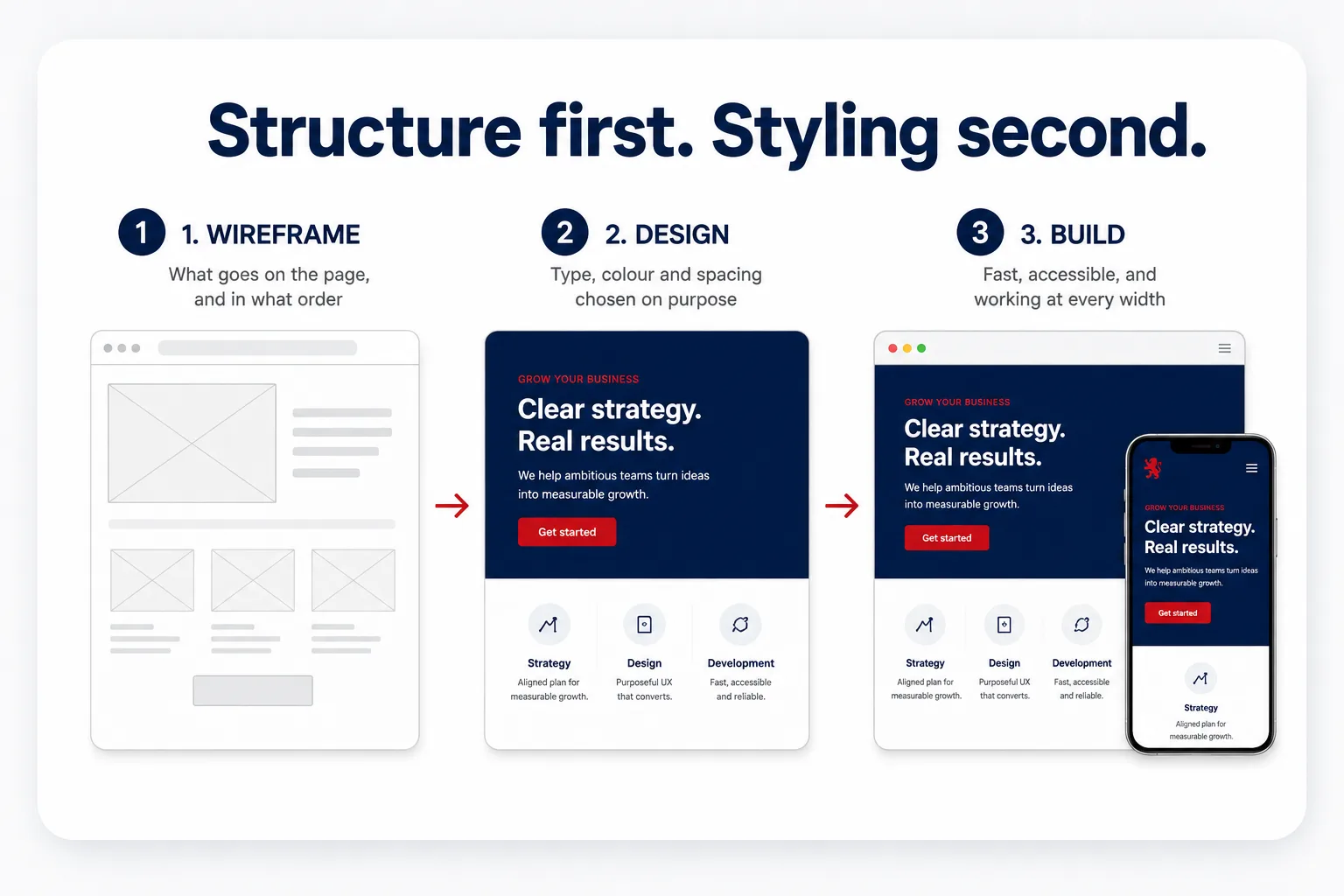
What a skimming reader catches in eight seconds: the claim, the proof, the action. Hierarchy is decided in the wireframe, then typography enforces it.
The conversion path
Phone, form, booking or purchase — chosen deliberately, placed where intent peaks, and instrumented so you can see it working.
Responsive by design
One design system. Every screen your buyer is on.
Same brand, same message, re-decided for each screen. The numbered callouts are the actual decisions being made.
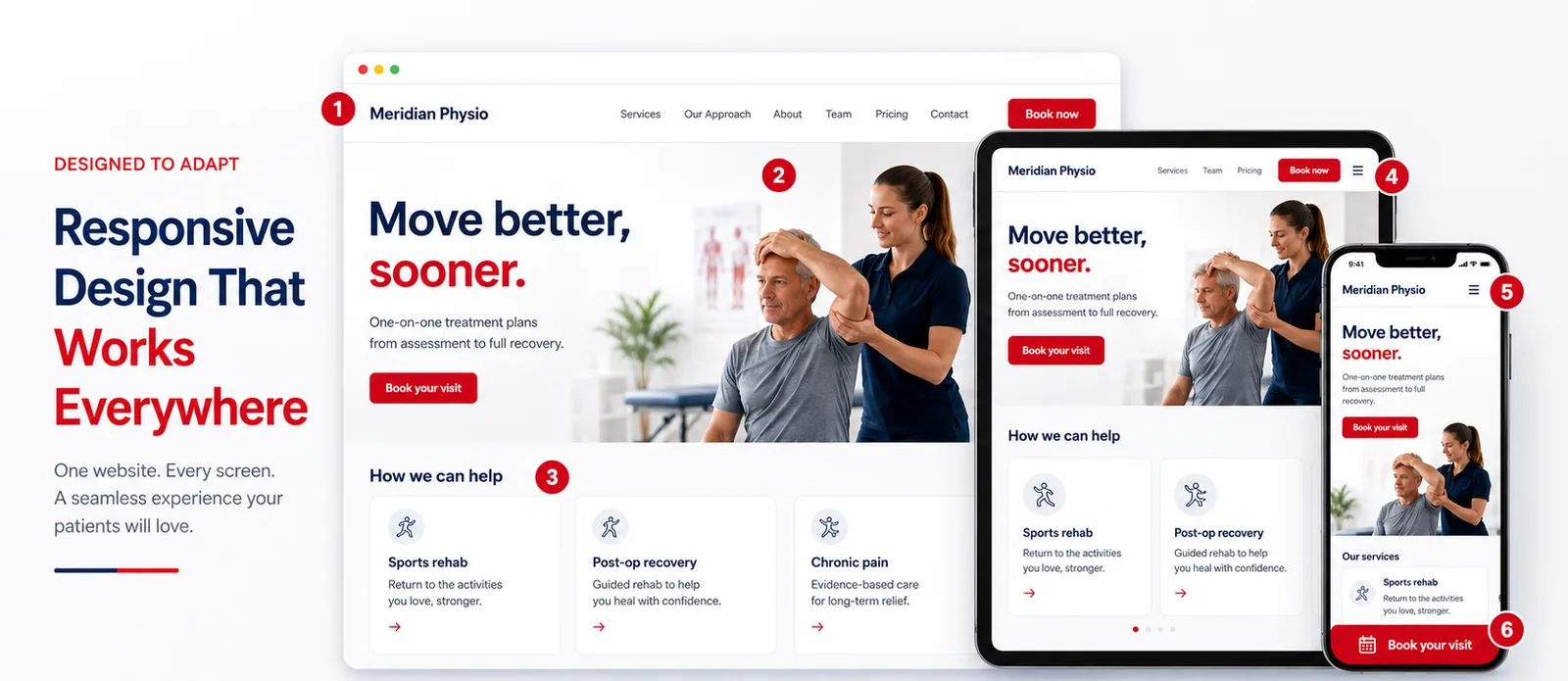
- 1Full navigationDesktop has room for every section plus a persistent call to action in the header.
- 2Image crop per screenThe same photo is art-directed per breakpoint — wide and cinematic here, cropped tighter as space shrinks.
- 3Three-column gridServices sit side by side where the viewport affords comparison at a glance.
- 4Navigation tightensOn tablet, lower-priority links drop first; the call to action shortens but never disappears.
- 5Menu collapsesOn the phone the menu folds into a burger — and the headline scale steps down on a type scale designed for small screens, not just shrunk.
- 6CTA in thumb reachThe booking action moves into a sticky bottom bar with a full-width tap target, because that is where sales actually happen.
Most of your visitors will only ever see the right-hand version. We design mobile as the primary experience and let desktop be the luxury edition — not the other way around.
The difference
Assembled from a template vs designed for you.
A theme, filled in
- Layout decided by whatever the theme shipped with
- Loaded with plugins and scripts you never asked for
- Slow on mobile, where most of your visitors actually are
- Looks like the other businesses using the same theme
- SEO bolted on afterwards, if at all
- Every edit needs a developer
A designed build
- Layout designed around the decision each page must drive
- Only the code the page actually needs
- Built mobile-first and tested at real device widths
- A visual system that belongs to your brand alone
- Structure, speed and schema in from the first page
- Handed over so your team can run it
Craft, specifically
The quiet things that make it feel expensive.
A premium site rarely announces itself. It is felt: type set on a real scale, spacing with rhythm instead of uniform gaps, colour used to mean something, pages that appear instantly and never shift under your finger.
These are engineering decisions as much as design ones, which is why we do not split the two jobs between vendors.
- Typography with intent — a deliberate scale and pairing, tuned for reading, not decoration
- Accessibility as default — semantic structure, keyboard paths, contrast and reduced-motion respect
- Core Web Vitals — speed treated as a design feature: fast paint, no layout shift, light pages
- Real content design — pages designed with your actual words and images, never lorem ipsum


A real rebuild
What changes when design is decided.


Dev Dheenshaw Construction, before and after. Same business, same services, same phone number — different decisions about structure, hierarchy and confidence.
How a build runs
From brief to launch, without the mystery.
Discover
We learn your brand, your buyer, and the one action each page should drive. You get a sitemap and a scope, and the quote that will hold.
Design
You see a real on-brand direction and the key page layouts with your actual content in them, and sign off before production code is written.
Build
Hand-built pages — fast, accessible, schema‑ready — with analytics wired in as we go, not bolted on at the end.
Launch
Tested at real device widths, migrated with redirects where anything moves, and monitored through the first live days.
Run
Handed over so your team can edit — or kept under managed updates, where routine changes generally land within one business day.

Platforms, honestly
The platform is a decision, not a default.
Some businesses need a site their team edits weekly — that is usually WordPress, built clean. Some need a storefront — that is a commerce platform chosen for the catalogue. Some need pages that will not change for a year and should simply be fast and bulletproof.
We choose with you, and we will happily explain why — including when the honest answer is the boring one.
- WordPress — when your team needs to publish and edit without a developer
- Commerce platforms — Shopify or WooCommerce, decided by catalogue and operations
- Hand-built static — when speed and stability matter more than weekly editing
- Your call, informed — the trade-offs in plain English before anything is built
Every element on the page has to earn its place.
A site that looks good but takes four seconds to load, buries the phone number, and cannot be edited without a developer is not a finished website. It is an expensive brochure.
The knowledge base
Every question we get asked about website design.
Straight answers, at the depth you would want before spending real money. If your question is not here, it is a ten-minute call.
The basics
What does a website designer actually do?
Less drawing than most people expect, and more deciding. The job starts with structure: which pages your business needs, what each page must say, and what a visitor should do at the end of it. Then hierarchy — making sure a skimming reader catches the right three things in the right order. Only then does the visual layer happen: typography, colour, imagery and layout that make those decisions legible and give the brand its feel.
On a 3 Lions build the same team also writes the copy, produces or reworks the imagery, and builds the pages, so the design survives contact with reality instead of being handed off and diluted.
Custom design or a template — what is the real difference?
A template is a layout someone designed for nobody in particular, which you then pour your business into. It is fast and cheap, and it shows: your structure bends to fit the theme, you carry code for features you never use, and you look like every other business that bought it.
Custom design starts from your buyer and your argument, so the structure fits the business instead of the other way round. It also means the site carries only the code it needs, which is most of why custom builds are faster. Templates are a fine choice for a hobby project or a placeholder. For a business whose site is supposed to win work, the difference is usually visible in the enquiry rate.
Who needs a custom website — and who honestly does not?
You need one when the site has a commercial job: winning enquiries, bookings or sales in a market where buyers compare you against competitors. You probably do not need one if the site is a formality — a menu and opening hours, a landing page for a side project, a one-event microsite. In those cases a well-configured simple setup is the honest recommendation, and we have told plenty of people exactly that on a first call.
What makes 3 Lions different from a freelancer or a big agency?
A freelancer usually does one part well — design, or code, or copy — and you assemble the rest. An agency does everything but through layers: account managers, handoffs, and a junior doing the actual work. We are a small senior studio: the people you talk to do the design, the words, the build and the search thinking as one job. That is why the quote is fixed, the timeline is real, and nothing gets lost between vendors.
Process & timeline
How long does a website take to build?
A focused business site — five to ten genuinely designed pages — typically runs a few weeks from kickoff to launch, with the pace set less by design and build than by how quickly content decisions and feedback come back. Larger sites, e-commerce builds and migrations run longer. We scope it precisely on the first call and give you a real timeline before starting; the timeline then holds unless the scope changes, and if it changes we say so in writing, not in the invoice.
What do you need from me during the project?
Three things, honestly delivered: facts about the business (services, areas, what makes you better — we interview you for this, you do not have to write it), whatever material exists (photos, logos, old copy, brochures), and decisions at two or three review points. The single biggest cause of delayed launches is feedback that takes three weeks. If you can turn reviews around in days, the project moves like it should.
How many revisions do we get?
The process is built so revisions happen where they are cheap: at the design stage, on real layouts, before production code exists. There we iterate until the direction is signed off — that is the point of the stage, not a numbered allowance. Once pages are built, changes within the agreed scope are included; new scope (extra pages, a new section type, a rethink of a signed-off direction) is quoted separately before we do it. Nobody gets surprised by an invoice.
Do you design with real content or placeholders?
Real content, always. Lorem ipsum designs collapse the moment actual words arrive — headlines run long, sections turn out unnecessary, and the layout was tested against nothing. Because we write the copy as part of the same engagement, layouts are composed with your actual message from the first draft. It is slower at the start and much faster overall.
Platforms & ownership
What platform will my site be built on?
Whichever one your situation argues for — the honest answer is that the platform is a consequence of how the site will be run, not a house default. Teams that edit and publish regularly usually get WordPress, built clean with a custom theme. Storefronts get Shopify or WooCommerce depending on the catalogue and operations. Sites that change rarely are often best hand-built and static: fastest, most stable, nothing to maintain. We explain the trade-offs in plain English and you make the call with us.
Will I own my website?
Completely. Domain, hosting account, code, content, images, analytics — registered to you, handed over at launch. If we disappeared tomorrow you would lose a supplier, not your website. We think anything else is a hostage arrangement dressed up as a service, and we do not do it.
Can you work with my existing hosting and domain?
Usually yes. We will review what you have — some hosting is genuinely too slow or restrictive for a modern build, and if so we will show you the numbers and recommend a move, typically a modest cost. Your domain never needs to move; it just points at the new site when we launch, which is a few minutes of change, planned so there is no downtime.
What happens to my site if we stop working together?
Nothing. Everything already belongs to you and runs without us. Any developer can pick up the code — it is standard, documented, and free of proprietary lock-ins. That is deliberate: we would rather be kept because the work is good than because leaving is painful.
Content, search & performance
Do you write the copy and produce the images too?
Yes, and we would rather you let us. Words and layout are the same argument: a headline that runs two lines changes the design, and a photo with the subject on the right decides where the text goes. We interview you for the facts, write to your buyer, and art-direct imagery — including reworking your existing phone photos to web standard, which is more often possible than people expect. There is a whole service page on this: Copy & Images.
Will my new site rank on Google?
The build gives ranking its best foundation: clean structure, fast pages, semantic markup, schema, descriptive metadata, and copy that actually answers what buyers search. What no honest studio will promise is a position — rankings also depend on your market, your competitors and your authority over time. If search is a primary goal, the SEO & SEM service continues where the build leaves off; if a rebuild is replacing an existing site, we map and redirect everything that already earns traffic so rankings are protected rather than reset.
How fast will the site be?
Fast enough that speed stops being a topic. We build against Core Web Vitals as a design constraint — light pages, optimised images with explicit dimensions, no layout shift, no plugin bloat — and we test on real devices, not just a desktop simulator. Speed is mostly the result of restraint: shipping only what the page needs. That restraint is a design decision, which is why it is part of the design service and not an optimisation bill afterwards.
Will the site meet accessibility standards?
Accessible structure is our default, not an upgrade: semantic headings, keyboard navigation, visible focus, alt text that describes, contrast that passes, and animation that respects reduced-motion settings. Beyond being right, it overlaps almost perfectly with what search engines and answer engines reward — and it widens the set of customers who can actually use your site. If your industry has formal compliance requirements, tell us on the first call and we will scope to them explicitly.
After launch
Can I edit the site myself after launch?
If you want to, yes — that preference shapes the platform choice at the start. Editable builds come with a walkthrough and a site your team can genuinely run: text, images, pages, products, without a developer on call. And if you never want to touch an admin screen, we offer the opposite arrangement instead: managed updates, where you email us the change and it is generally live within one business day. Most clients land somewhere in between.
What does ongoing maintenance involve — and do I need it?
It depends on the platform. A static hand-built site needs almost nothing: hosting renewals and occasional content updates. A WordPress or commerce site needs regular core and plugin updates, backups and monitoring — routine when done on schedule, expensive when ignored for a year. We offer a light monthly care arrangement for exactly that, or we hand you a plain-English checklist and you run it yourself. Both are legitimate; what is not legitimate is nobody doing it.
What does a website like this cost?
A fixed quote against an agreed scope — never an hourly meter. The price moves with how many pages need genuinely custom design and what has to be produced for them (copy, photography, illustration), which is why we scope first and quote second. The quote then holds. As honest context: a designed business site is a four-figure project, not a few hundred dollars — and the difference between it and a template is usually visible in the first month of enquiries.
Let’s design something that’s yours.
Tell us what the site needs to accomplish and we’ll show you how we’d approach it — structure first, honestly quoted.