Onboarding
The jobs every new hire has to learn, written once instead of explained from scratch every time.
Business Development
Standard operating procedures short enough to use on the floor and precise enough to rely on when it matters.

The real cost
Which is fine until they are on holiday, or leave, or do it slightly differently on a Friday. Then the same job produces a different result and nobody can say which one was correct.
Documenting how the work is done is what lets you hand it to someone new, hold a standard, and stop being the only person who knows.
How the writing actually happens
We watch the process run for real, note where it varies by person, and collect what already exists — checklists, screenshots, tribal memory.
Short sessions with the people who do the work and the person accountable for it. The workarounds they mention in passing are usually the real procedure.
The process drawn end to end, including the exception paths. Disagreements surface here, on a diagram, instead of later on the floor.
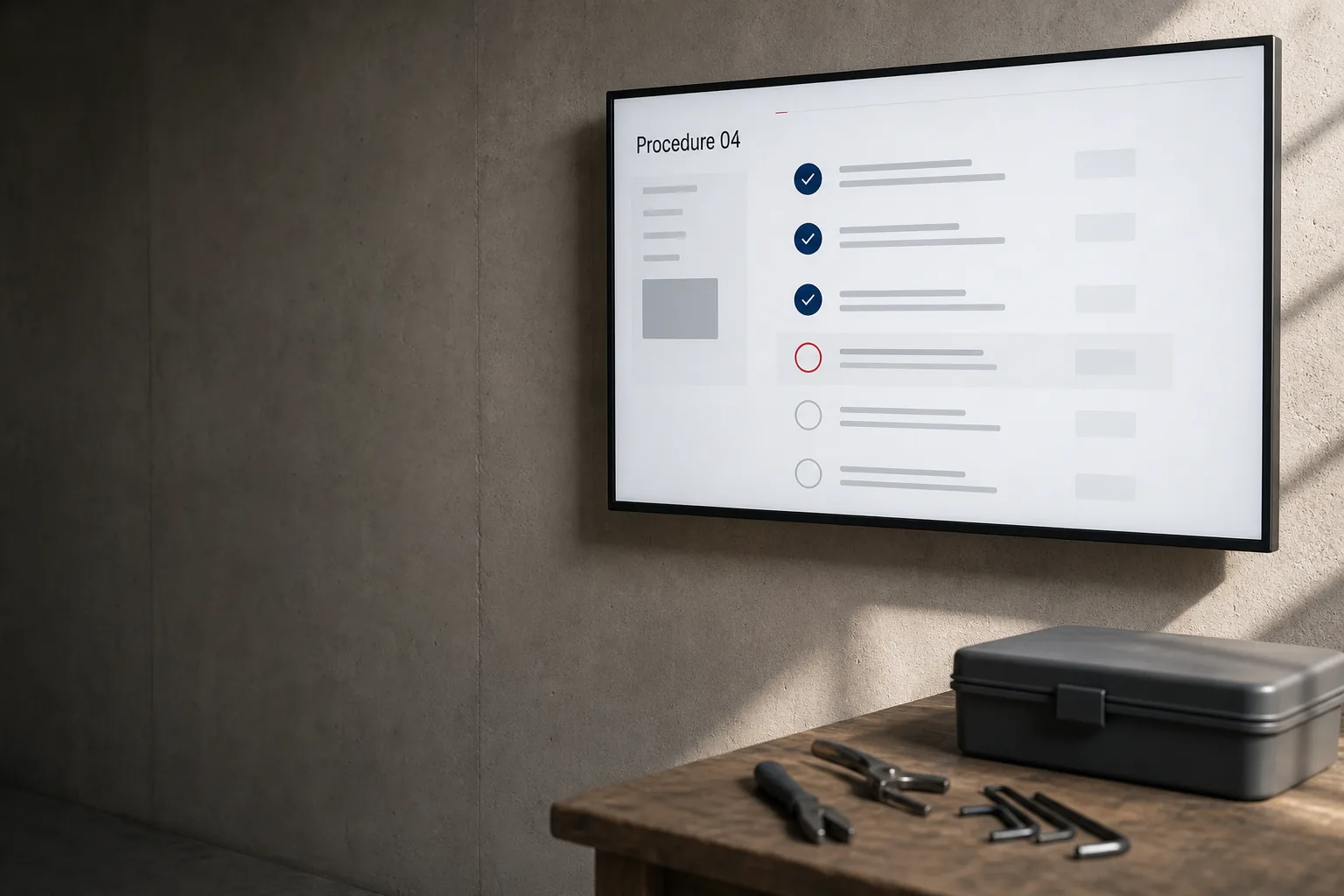
Steps short enough to follow mid-task, in the language your team actually uses, with photos or screenshots where words are slower.
The people who do the work check it against reality; the owner signs it. Version one is dated, numbered and effective from a stated day.
A named owner, a review cadence, and a revision history — so the document stays true as the process evolves instead of quietly rotting.
Two ways to run a process
Undocumented
Documented properly
The shape of a usable SOP
The document itself
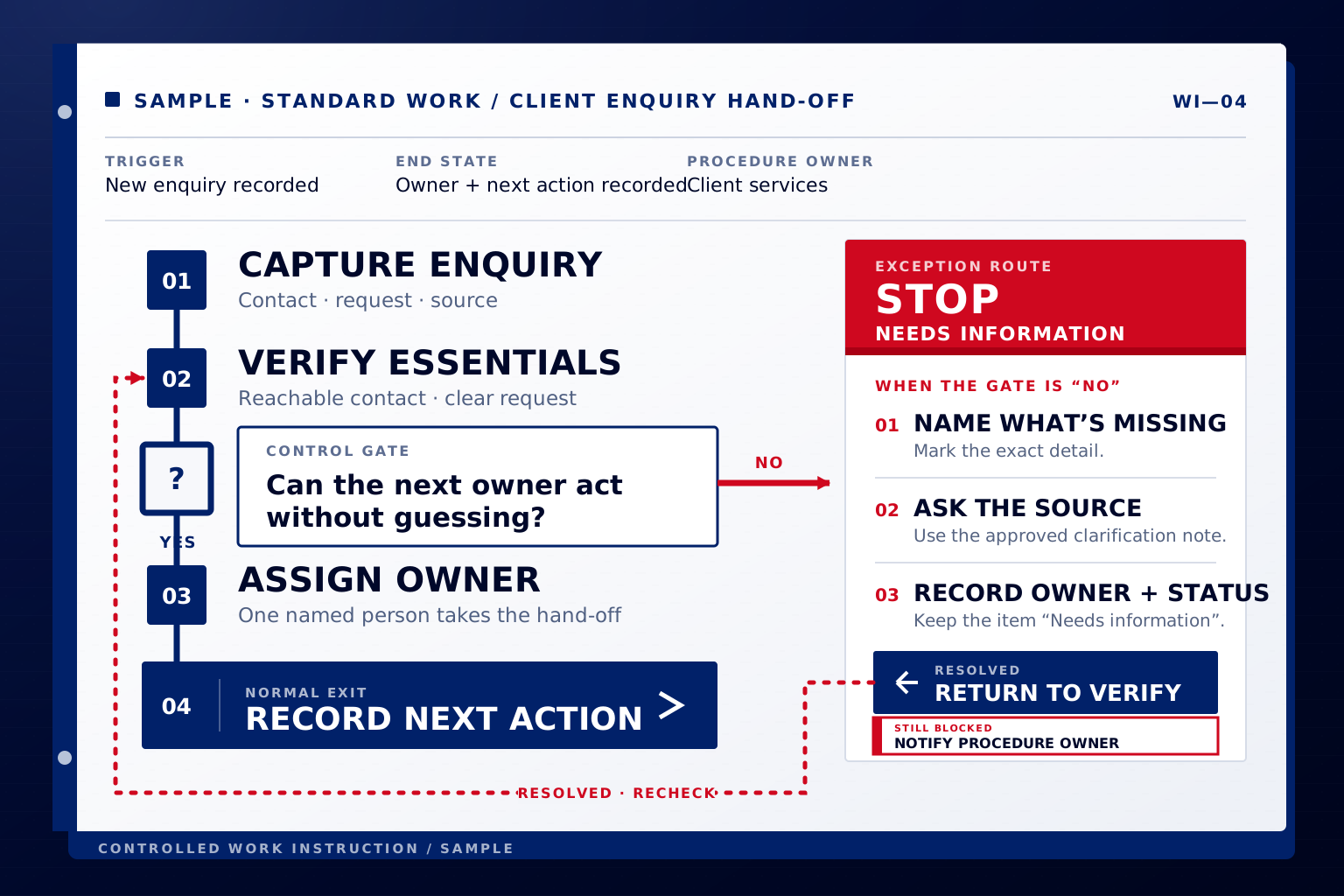
An operations manager can tell in ten seconds whether a procedure is real: it has a number, a version, an owner, an effective date, and a revision history that shows someone maintains it. That control block is not bureaucracy — it is what makes the sheet safe to rely on during an audit, a dispute, or a bad Tuesday.
The sample here is our own format. Steps stay short enough to follow on the floor, the exception path is printed beside the happy path, and every change is dated and owned.
Where they earn their keep
The jobs every new hire has to learn, written once instead of explained from scratch every time.
Work where being able to show what you did, and when, matters as much as doing it.
Steps where getting it wrong is expensive, dangerous, or hard to walk back.
The gaps where work changes hands and things quietly get dropped.
Single points of failure in your own business, usually including you.
You cannot automate a process nobody has written down. This is the step people skip.
The best SOP is the shortest one that still works.
Length is not thoroughness. A procedure people actually open beats a comprehensive one nobody reads, every single time.
The knowledge base
SOP writing sounds dry until the day it is priceless. These are the real questions.
Three levels of the same intent. A standard operating procedure is the controlled document: numbered steps, the exception path, an owner, a version, approvals — the thing an auditor or a new supervisor trusts. A work instruction zooms into one step in detail (how, exactly, to grade an item). A checklist is the execution surface — the tick-boxes on the floor that prove the procedure ran. Mature operations use all three, generated from one source of truth so they never disagree. We write whichever layers your risk actually justifies; not every process deserves the full stack, and over-documentation is its own failure.
Rank by pain, not alphabet: anything only one person knows (the bus-factor list), anything where errors are expensive or dangerous, anything regulators or insurers can ask you to prove, the processes every new hire must learn, and the handoffs where work goes quiet between people. That usually yields a first tranche of five to ten procedures that carry most of the operational risk. Documenting those beats a hundred trivial ones — an SOP library is a risk instrument, not a stamp collection.
Brutal usability. Written in the words the team actually uses; short enough to follow mid-task; the exception path printed beside the happy path (the moment people improvise is when it goes wrong, and it is exactly the moment generic SOPs go silent); photos or screenshots where a picture beats a paragraph; and available where the work happens — bench, tablet, terminal — not buried in a drive. And one more thing that is cultural rather than editorial: the people who do the work reviewed it before it became law, so it describes reality instead of a manager’s memory of reality.
As detailed as the risk, and no more. A payroll-processing SOP earns precision a stationery-ordering one does not. The practical test: could a competent new hire execute this correctly on their first unsupervised attempt, and would an auditor accept it as evidence of control? Below that bar, add detail. Above it, you are laminating bureaucracy — length is not thoroughness, and a procedure people stop reading is a procedure that has already failed.
By watching it run, not by asking for a description of it. We observe the work at the pace it actually happens, interview the people who do it and the person accountable for it, and pay particular attention to the workarounds mentioned in passing — those are usually the real procedure, evolved for reasons nobody wrote down. Then the process gets mapped end to end, including exceptions, and disagreements about “how it works” surface on a diagram where they are cheap, instead of on the floor where they are not.
Six honest stages, visible on this page: discover (watch, collect, inventory what exists), interview, map, write, review-and-approve (the people who do the work check it against reality; the owner signs; version one gets a date), then control (numbering, ownership, review cadence). For a library engagement we sequence procedures by risk and batch the interviews so your team is disturbed as little as possible. You see drafts early — the fastest way to a wrong procedure is writing all of them before showing anyone.
Usually the best-value engagement we offer. Libraries rot predictably: procedures describe the process of three years ago, staff follow an oral tradition instead, and nobody owns updates. We audit what exists against what actually happens, keep what is true, rewrite what people have stopped following, retire what deserves it, and — the part that prevents re-rot — install the control layer: one numbering scheme, named owners, review dates, a home for the next new procedure. The deliverable is not a pile of documents; it is a system that stays true.
Only if they are written as monuments. Fast-changing processes get documented at the level that is stable — the decision structure and quality bar, not the pixel-level clicks that shift with every software update — and the volatile detail lives in work instructions that are one small edit, not a project. Combined with named ownership and a review cadence, change becomes a five-minute version bump. The alternative — documenting nothing because things change — is how businesses end up owning nothing but tribal memory with turnover.
The discipline that answers four questions an auditor, an insurer, a lawyer or a new manager will eventually ask: which version is current, who approved it, when did it take effect, and what changed since last time. Mechanically it is the header block and revision table on the sample sheet above — trivial to maintain once installed, impossible to reconstruct after the fact. If your industry is regulated the answer is simply yes. If not, you still want the lightweight version the first time a warranty dispute, an insurance claim or a termination case turns on “what was the procedure at the time?”.
They are the backbone of them. Certification schemes and regulator audits substantially reduce to: show us your documented procedures, and evidence that reality follows them. Controlled SOPs with owners, versions and approvals are exactly that evidence. We write to the structure your certification body expects where one is in play, and we will say plainly that we author the documentation layer — a full certification project also involves auditors and consultants for the scheme itself, and we work happily alongside them rather than pretending to replace them.
A good procedure is nine-tenths of a training module already — the steps, the why, the failure modes. We write SOPs so they convert cleanly: purpose becomes the lesson objective, steps become the demonstration, exceptions become the scenario questions, and the sign-off check becomes the assessment. Paired with our Courses & Training service, the same source of truth trains the new hire and governs the veteran, which is the only arrangement where the two never contradict each other.
Wherever the work happens: print-ready sheets for benches and walls, digital masters in your drive or intranet with the control fields live, tablet-friendly checklists where execution is mobile, and screenshots embedded where the process is software. Format follows use — the shipping bay gets the laminated card, the finance process gets the linked digital doc — and every format is generated from one controlled source so they cannot drift apart.
A single well-scoped procedure — observed, interviewed, mapped, written, reviewed — is measured in days. A first tranche of the five-to-ten highest-risk processes is a few weeks, dominated by scheduling time with your people rather than by writing. A full library with control system is a phased project we sequence so value lands as we go: your riskiest procedure is protected in week one, not after the whole library ships.
Per-procedure for small engagements, project-scoped for tranches and libraries — fixed either way, quoted after we see the terrain. The honest cost drivers: how complex and exception-laden the process is, how available your people are for observation and review, and how much rescue versus green-field writing is involved. Compare it against the cost the SOP retires: one bad quarter of undocumented-person-quits is usually several libraries’ worth of consulting.
Yes — observing real work means seeing real work, and we treat that access accordingly. NDAs signed before anything starts, drafts kept inside your systems where preferred, and nothing from any client’s operations reused anywhere, ever. The sample procedure on this page is invented for exactly that reason. Confidence that we keep confidences is, in this service more than most, part of what you are buying.
Tell us which process would hurt most to lose and we’ll start there.