

What changed
Search collapsed into one answer.
A growing share of buyers now ask an assistant instead of scanning a results page. They get one synthesised answer, assembled from a handful of sources the model considered trustworthy, and they act on it.
You are either inside that answer or you are invisible. Ranking eleventh has always been bad; in an answer that names three businesses, it does not exist at all.
From business truth to being cited — how GEO works in one picture
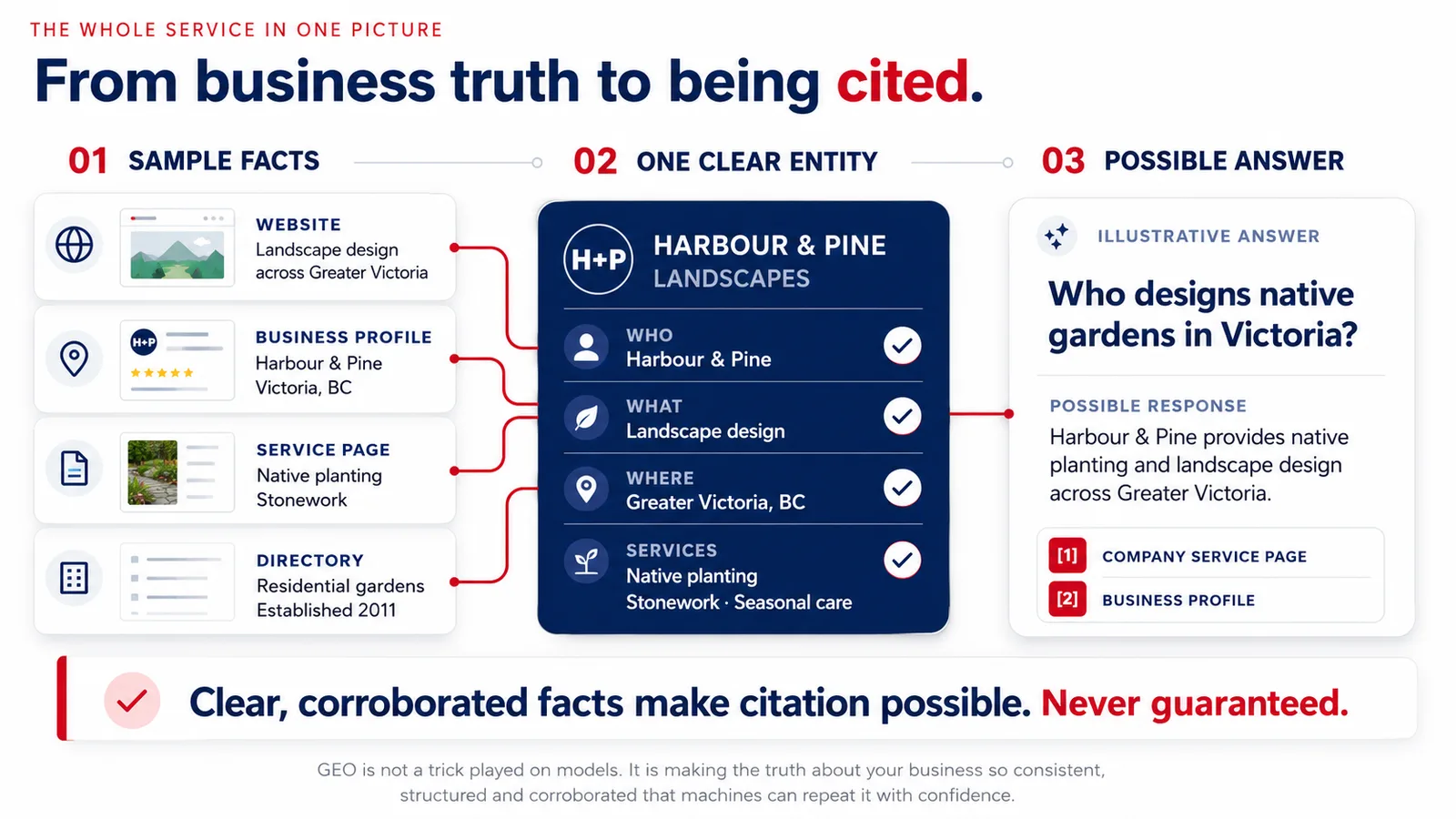
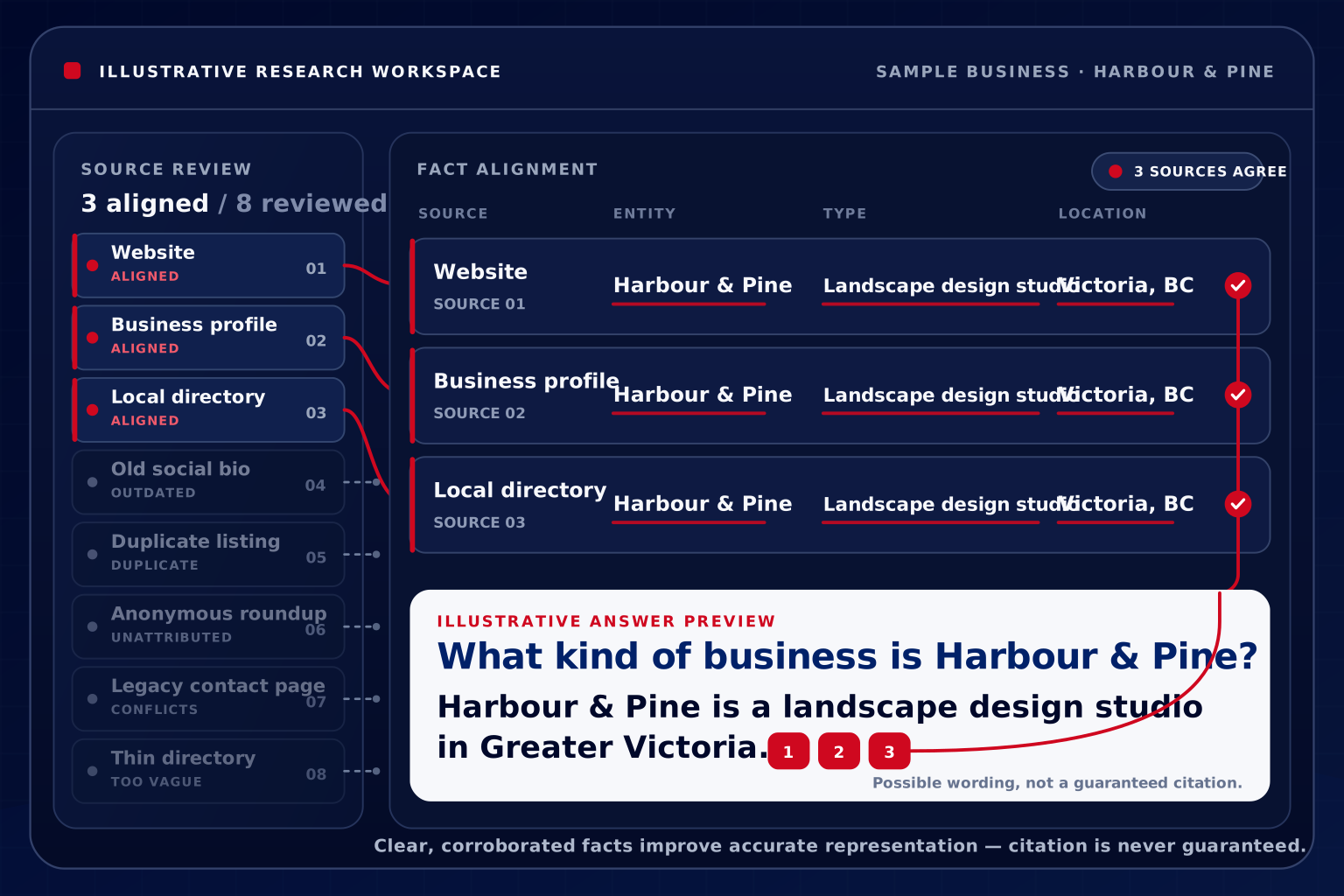
How an answer gets assembled
Three sources make it. Five do not.
Same foundation, different target
SEO ranks a page. GEO gets you quoted.
Optimising only for rankings
- Success measured purely by position on a results page
- Content written to hit a keyword density
- Facts about the business scattered and inconsistent
- No structured data telling engines what anything is
- Invisible the moment a buyer asks an assistant instead
Also optimising to be cited
- Success measured by whether models name you at all
- Content written to answer the question directly and quotably
- One consistent, unambiguous set of facts about your business
- Schema and clean markup so the facts survive extraction
- Present in the results page and inside the generated answer
How an engagement runs
From invisible to cited.
Audit
We ask the major assistants about your category today and record exactly how — and whether — you appear in the answers.
Structure
We tighten entities, schema and on-page facts so a model can read your business without guessing or contradicting itself.
Publish
We author content against the questions your buyers actually ask, written so a passage can be lifted and attributed cleanly.
Monitor
We re-check citations on a cadence and keep working the prompts where the engines still hesitate.
Nobody can guarantee an AI will cite you.
No agency controls what a model says, and anyone promising guaranteed citations is selling something. What we can do is remove every reason for a model to skip you, then measure honestly whether it worked.
The knowledge base
GEO, answered without the mystique.
A new discipline attracts fog. Here is the clear version.
What it is
What is Generative Engine Optimization, in plain terms?
Making your business easy for AI systems to understand, verify and describe accurately — so when someone asks ChatGPT, Perplexity, Gemini or Google’s AI results who does what you do, you are part of the answer instead of invisible to it. Practically it is structural work: consistent facts everywhere your business appears, pages that answer real questions directly, schema markup that states things machines can parse, and the corroborating mentions that let a cautious model trust what your own site claims.
How is GEO different from SEO?
They share a foundation and diverge at the finish line. SEO optimises to rank a page in a list of links; GEO optimises to be quoted inside a synthesised answer. The overlap is large — clean structure, real content, authority — which is why GEO is usually an extension of good SEO rather than a rival budget. The differences are real though: answer engines reward direct, quotable explanations and machine-readable facts more heavily, care more about consistency across the whole web, and produce answers where there is no position eleven — you are in the answer or you do not exist.
Do people actually find businesses through AI assistants?
Increasingly, and disproportionately at the decision end of the journey. Someone asking an assistant “who should rebuild my company’s website in Victoria” is not browsing — they are shortlisting. The volumes are still smaller than classic search, but the intent is concentrated, and the shift is one-directional: every major search surface is becoming an answering surface. Positioning for it now is cheap; retrofitting after your competitors are the answer is not.
Can anyone guarantee my business gets cited by AI?
No — and anyone who does is selling something. Models decide answers probabilistically, per question, per moment; nobody outside those companies controls the output. What is controllable is every reason a model might skip you: ambiguous facts, contradictory listings, pages that never actually answer anything, zero corroboration. We remove those reasons, then measure honestly whether the engines’ descriptions of your category improve. That is the entire honest promise available in this field, from us or anyone.
The work itself
What does entity clarity actually involve?
An “entity” is what machines call the stable thing behind the words — your business as a node: name, type, services, service area, contacts, relationships. Entity work makes that node unambiguous: one canonical name used identically everywhere, services described in consistent terms, address and hours matching across your site, Google Business Profile, directories and socials. Machines cross-check relentlessly; every small contradiction (an old address here, a different phone there) is a reason to be less sure about you, and unsure entities do not get confidently named.
What is schema markup and why does it matter here?
A vocabulary for stating facts in code, invisibly attached to your pages: this is a LocalBusiness, named X, serving Y, offering Z, open these hours. Humans never see it; machines read it as confirmation of what the visible page says. It is not a magic ranking lever — it is disambiguation. In GEO terms it converts prose a model must interpret into statements it can simply ingest, which lowers the cost of being certain about you. We write it truthfully or not at all; schema that overstates is a trust liability, not an asset.
What kind of content wins citations?
Content that answers a real question completely, early, in words a model can lift cleanly: definitions that define, processes with actual steps, prices explained honestly, comparisons that commit. Pages structured with meaningful headings and full-sentence answers — like the FAQ you are reading — are extraction-friendly by design. What loses: vague brochure prose (“we deliver tailored solutions”), content that circles a topic without landing, and anything the model can find said more clearly by a competitor.
Do directories, reviews and mentions still matter?
More than ever, but for a new reason. To a cautious model, your own website is a claim; third-party corroboration is evidence. Consistent listings, genuine reviews, industry mentions and local citations all confirm the same entity story your site tells. This is not the old link-building numbers game — a handful of accurate, reputable corroborations beats hundreds of junk listings, and inconsistent listings are actively harmful because they reintroduce doubt about facts you worked to make unambiguous.
Engines & fit
Which engines and assistants does this target?
The surfaces people actually ask: ChatGPT, Google’s AI Overviews and AI Mode, Gemini, Perplexity, and Copilot — plus the classic results pages that now sit underneath them. The encouraging part: they all reward substantially the same structural honesty, so the work is done once, not per engine. We track how each one describes your category because they differ in the details — one may know your services but not your area, another the reverse — and those gaps tell us what to fix next.
Do I need GEO if my SEO is already working?
Increasingly they are the same job with two scoreboards. Ranking well is no longer the same thing as being in the answer — plenty of businesses hold page-one positions while the AI summary above those positions names three competitors. If buyers in your category ask assistants for recommendations (and in local services they already do), the answer layer is new territory your rankings do not automatically occupy. The good news: your SEO equity is the perfect foundation, and extending it costs far less than starting cold.
What does GEO work cost and how is it scoped?
Like our other services: scoped first, quoted fixed. A typical engagement starts with the audit — what the engines currently say about you and your category, where your facts contradict themselves, what structure is missing — which produces a concrete work list: entity and consistency fixes, schema, answering content, corroboration. Some businesses need a focused one-time pass; competitive categories justify an ongoing cadence of content and measurement. You will know which you are, and what it costs, before anything begins.
Measurement & expectations
How do you measure GEO progress?
Directly: we ask the engines. On a recurring cadence we put the questions your buyers actually ask to the major assistants and record whether you appear, how accurately you are described, and who else is named. That produces a visibility record over time — from “absent” to “named with correct services” is real, trackable movement. We also watch assistant-referred traffic where analytics can see it. What we do not do is invent a proprietary “GEO score”; the field is too young for pseudo-precision, and honest measurement beats impressive dashboards.
How long before anything changes?
Structural fixes (facts, schema, consistency) are readable by machines within weeks. Movement in actual answers is slower and less linear than classic SEO — models retrain and refresh on their own schedules, and answers vary by phrasing. A fair expectation: measurable description-accuracy improvements inside a few months, citation appearances building after that, faster in specific local categories, slower in crowded generic ones. Anyone promising day-thirty citations is guessing with confidence.
Does GEO work hurt or help my normal Google rankings?
Helps, almost mechanically. Everything GEO rewards — clarity, structure, real answers, consistent facts, corroboration — is also what classic search has spent a decade learning to reward. The work is one body with two beneficiaries, which is why we treat GEO as an extension of the search foundation rather than a separate product with a separate invoice. There is no trade-off to manage; badly-done GEO is just badly-done SEO with newer vocabulary.
Is this only worth it for certain kinds of business?
The economics are best where questions have shortlist answers: local services, specialist providers, considered purchases — anywhere a buyer would naturally ask “who should I use for X in Y”. If you sell a commodity on price to the whole planet, answer-engine naming matters less than your ads and your logistics. We will tell you which side of that line you are on before you spend, because a service sold to everyone is a service sold dishonestly to someone.
See how AI describes your category.
Book a short call and we’ll check what the assistants say about your space today — and whether you are in the answer.