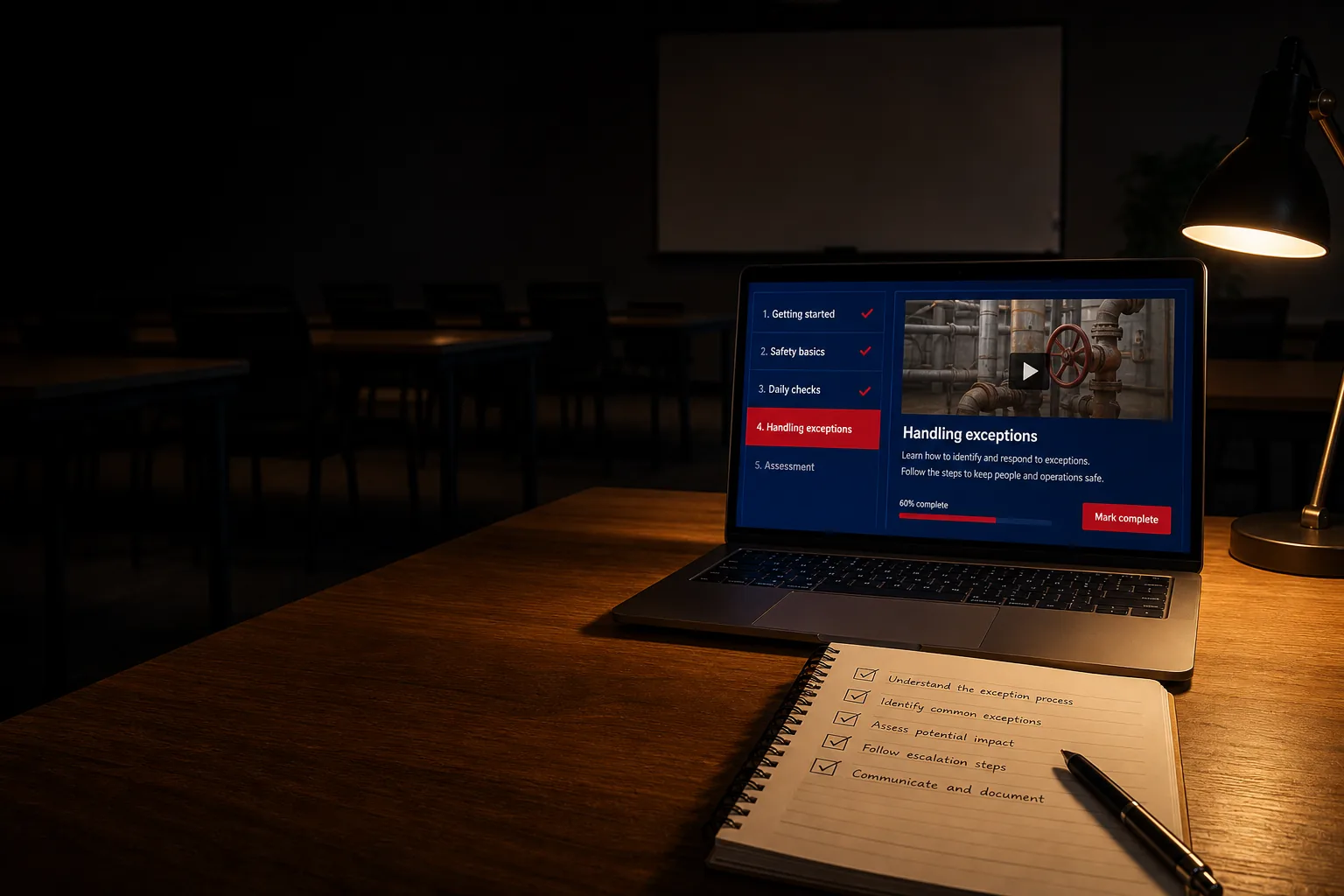
Onboarding programmes
The path a new hire follows in their first weeks, so it stops being improvised by whoever is free.
Business Development
Courses and internal training designed for completion and retention — short modules, real practice, and proof it landed.
Training fails politely. People click through, the box gets ticked, and nothing changes on the floor.
We build courses the other way round: designed backwards from what someone must be able to do, in pieces short enough to finish, with checks honest enough to mean something.

Why training gets ignored
A ninety-minute recording, a slide deck nobody reopens, and a quiz at the end that proves only that someone clicked through it. It satisfies the requirement and teaches almost nothing.
Training that works respects the learner’s time: short pieces, a clear reason to care, real practice, and a way to tell whether it actually stuck.
How a course gets built
What should someone be able to do afterwards that they cannot do now? Everything else follows from answering that precisely.
Small pieces, each with one job, each finishable in a sitting — because completion is what produces competence.
Every module ends with something the learner does, not just watches. That is where the material moves from familiar to known.
Assessment designed to reveal whether someone can actually perform the task, rather than whether they remember the slide.
The shape of a course that finishes
From what you know to what they learn
What the business already holds, in whatever shape it is in.
Broken into short pieces, each with one job and a clear outcome.
Video, text and diagrams with something to do, not just watch.
Completion and assessment you can actually stand behind.
What we deliver
The path a new hire follows in their first weeks, so it stops being improvised by whoever is free.
Structured courses for the things your team has to do well, built from how your business actually does them.
Turning your expertise into a course you can sell or offer, designed to be finished rather than refunded.
Session plans and notes so someone other than the author can run the training without it degrading.
Checks that reveal genuine capability rather than short-term recall.
Updating existing material that has drifted out of date rather than rebuilding it from scratch.
A course nobody finishes taught nobody anything.
Completion is not a vanity metric in training — an unfinished course teaches nothing at all. Designing for it is the difference between material that changes how people work and material that satisfies a requirement.
The knowledge base
For owners, ops managers and anyone whose “training programme” is currently a veteran employee and hope.
Four families, usually. Onboarding programmes — the structured first weeks that stop new hires learning by folklore. Internal skills training — the procedures and systems your team must execute consistently, often built directly from your SOPs. Customer education — courses that teach clients to use what you sell, which quietly reduces support load and churn. And product or process rollouts — when something changes and forty people need to change with it. All interactive, all completable, all measurable.
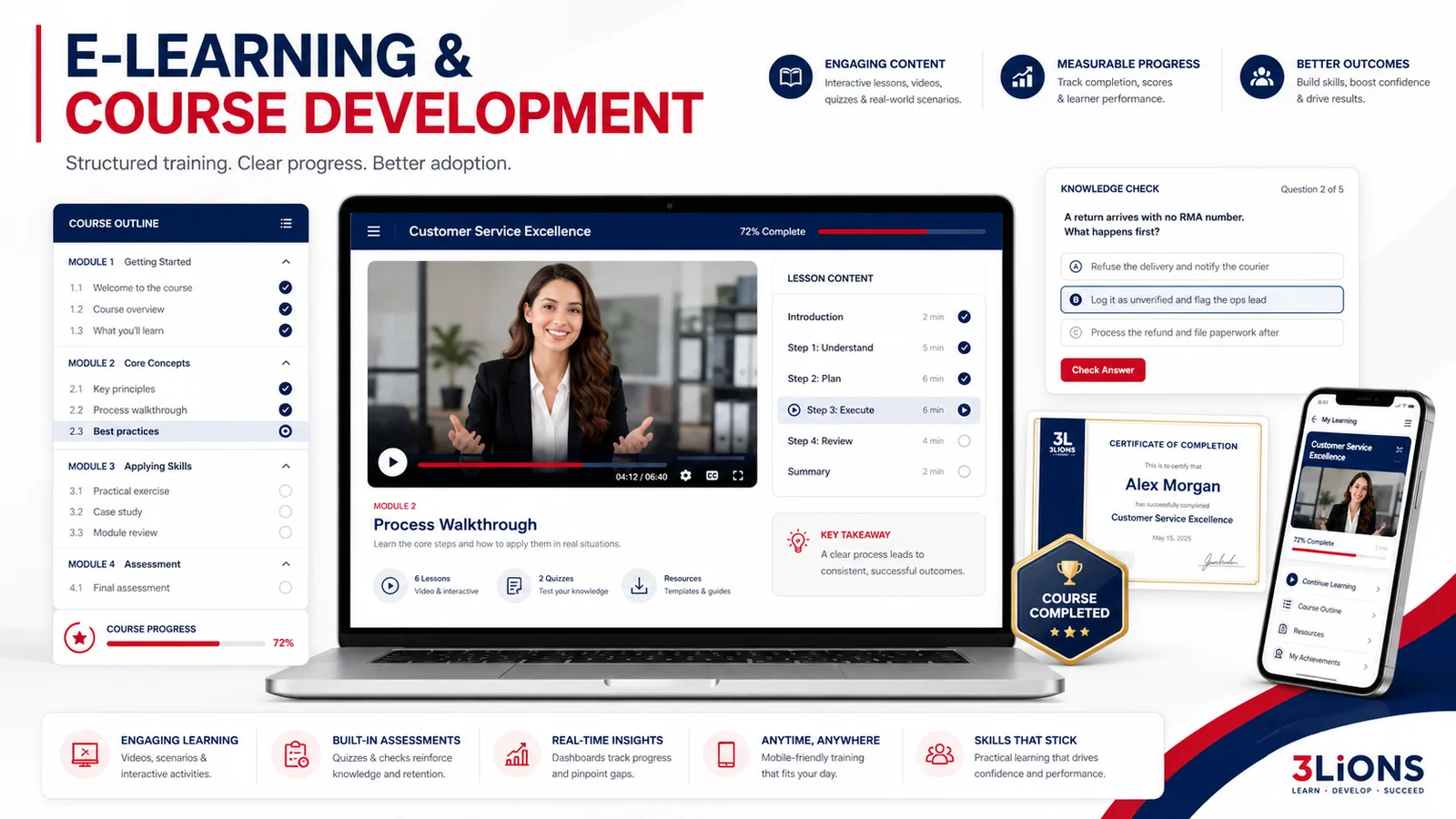
Something to do, not just watch. Every module pairs its content — video, text, diagrams — with an act: answer the scenario, make the judgement call, complete the practice task. The lesson interface on this page is the real shape: a knowledge check gates the next module, so completion means the person did the thing and answered correctly, not that a video finished playing in a background tab. Interaction is not entertainment; it is how material moves from familiar to known.
That is the most common engagement, and the most efficient. Good procedures are nine-tenths of a curriculum already: the purpose becomes the learning objective, steps become demonstration, exceptions become scenario questions, sign-off becomes assessment. The knowledge-to-course chain on this page is literally that pipeline. Where documentation is thin, we interview your subject-matter people and capture it as we build — many clients end up with better SOPs as a by-product of the course project.
Both. We work from your expertise — documents, interviews, watching the work — then write, structure and produce the modules: scripts, screens, diagrams, questions. You review for accuracy; we own instructional design and production quality. The division matters because subject experts are usually the wrong people to write their own training: they skip the steps they no longer notice, and those missing steps are exactly what novices trip over.
Because most courses are built to be delivered, not completed: ninety-minute recordings, walls of text, progress bars that barely move. Completion design is specific: modules short enough to finish in a sitting (five to twelve minutes), visible progress that rewards momentum, one clear objective per piece, and interaction that keeps attention honest. People finish things they can see the end of. Our completion assumption is built into the architecture, not appended as encouragement emails.
By testing the task, not the trivia. A weak check asks “what percentage did the slide say?”; a real one presents the situation — a return with no RMA number, an angry caller, a form that will not validate — and asks what you do first. Scenario-based checks measure judgement, which is what you actually pay training to produce. We also gate progression on them and, where the stakes justify it, schedule reinforcement checks weeks later — retention is built by retrieval, not by rewatching.
Designed for it. Modules are phone-first because that is where deskless teams actually learn — in the van, on break, between jobs. Short pieces suit interrupted time; progress syncs so a lesson started on a lunch break finishes on a laptop later. For shift-based teams we structure paths so a cohort can move through on their own schedules while managers still see exactly who has completed what by the deadline.
It must, or it trains for a job that does not exist. Software training uses your actual screens, captured and annotated. Physical procedures use photos and video of your real bench, your real machine, your real forms. Generic stock training footage teaches people to recognise stock footage. Where confidentiality applies we anonymise data in captures — but the environment stays yours, because transfer to the floor is the entire point.
Whatever fits how you work — we build for your existing LMS if one exists, set up a lightweight hosted platform if not, or deliver structured interactive modules inside tools your team already opens daily (including Google Workspace, where a surprising amount of solid training can live). We would rather fit your stack than sell you a learning platform you do not need; the platform is plumbing, and the course is the product.
Completion and assessment reporting is scoped in from the start: who finished, who is stuck and where, what the check scores say about which module is not landing. That last one matters most — if half the team stumbles at module four, module four is the problem, and we fix the module rather than blame the team. For compliance-driven training, the record doubles as your evidence trail: who was trained on which version, when, with what result.
Rule of thumb: an hour of finished interactive learning is weeks of build, not days — scripting, screens, interactions and checks all take real production. A focused onboarding path built from existing SOPs lands quickest; a full multi-module programme with video is a phased project where the first modules ship while later ones are still in production, so value starts before the whole thing is done. We scope precisely once we have seen the source material.
Fixed per scope, and driven by three things: how much finished learning time you need, how media-heavy it is (screen-capture and diagrams are cheaper than shot video), and how much source material exists versus must be extracted from your experts’ heads. The comparison that matters: what does the current informal training cost you in a veteran’s shadowing hours, inconsistent execution and slow ramp — every cohort, forever? Structured training is a build-once asset against a recurring invisible bill.
Often enough that asking is part of our first call. If the task changes monthly, a course calcifies — you want a living SOP and a five-minute walkthrough instead. If only two people ever do the job, shadowing beats production costs. If the real problem is a broken process, training people to execute it faithfully just standardises the damage — fix the process first (that is our Workflow Consulting lane). We will tell you which case you are in before you spend course money on a non-course problem.
Deliberately, as one operational stack. SOPs define how work should run; training moves that knowledge into people; automation removes the parts no person should be doing at all. Built together, they share one source of truth — the procedure trains the human steps, the automation handles the mechanical ones, and neither contradicts the other. Clients often arrive for one of the three and end up sequencing all of them, because each makes the next cheaper.
Tell us what your team needs to be able to do and we’ll show you how we’d build it.